How to Uninstall Firefox on Mac and Clear the Leftovers
To uninstall Firefox on a Mac, quit Firefox, open the Applications folder in Finder and drag Firefox to the Trash, which is the method Mozilla's own help page gives. That leaves your bookmarks, passwords and history behind. To erase them, delete the Firefox folder in ~/Library/Application Support, then clear its cache folders.
This guide on how to uninstall Firefox on Mac adds what Mozilla's short page skips: saving your data first, the backup file, the cache and a final check.
Why dragging Firefox to the Trash is not enough
Mozilla keeps your data apart from the app. Its profiles page says your profile lives in a separate place. Its uninstall page confirms that removing the app leaves bookmarks, history, passwords and cookies behind.
The Trash drag also skips the disk cache, downloaded updates, a settings file and any backup file. None of it harms your Mac. It just keeps your browsing data on disk.
The good news: Firefox is simple to remove. Security apps like Kaspersky come with their own uninstaller, and Kaspersky says to use it. On the Mac we checked, Firefox had added no login item and no background helper.
Trying to fix a problem? Refresh Firefox first
If Firefox is slow or crashing, a reinstall is often the wrong tool. Mozilla's Refresh Firefox builds a fresh profile and keeps what matters.
- Choose Help in the menu bar, then More troubleshooting information.
- Click Refresh Firefox, then click Refresh Firefox again to confirm.
- Firefox restarts. Click Finish, choose whether to restore your windows and tabs, then click Let's go!
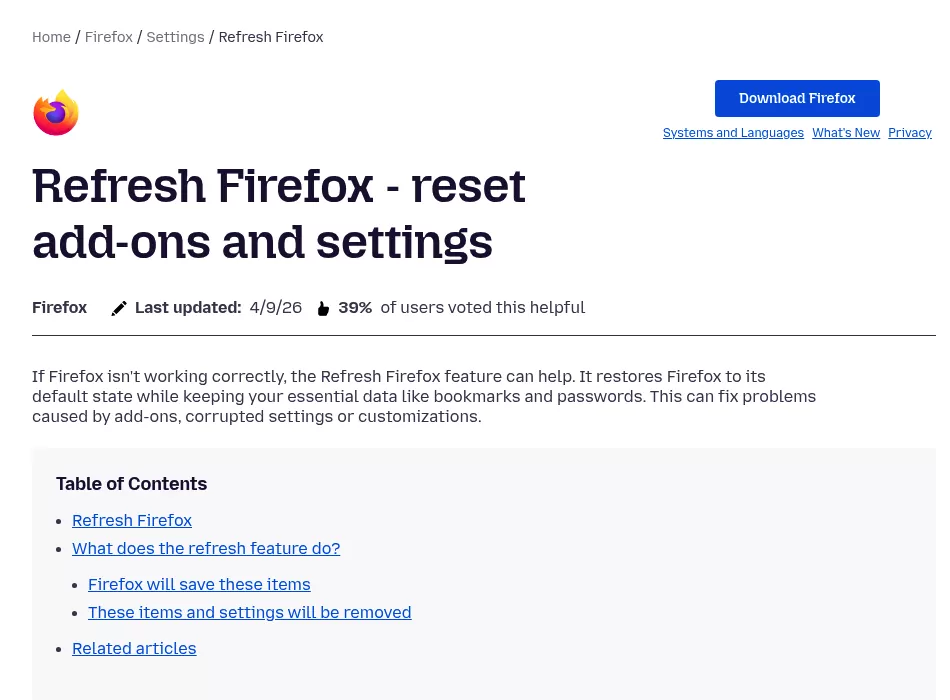
Refresh keeps bookmarks, history, passwords, cookies and form data. It removes add-ons, themes, site permissions and changed settings. It also leaves your old profile on the Desktop in a folder named Old Firefox Data, which holds private data, so delete it when you are done.
Want to test first? Troubleshoot Mode turns off add-ons for one session: click the menu button, then Help, then Troubleshoot Mode, then Restart and Open. If you reinstall only to fix a fault, keep your profile and skip Steps 2 to 5.
Before you uninstall Firefox on Mac
Do these while Firefox is still on your Mac.
Export your bookmarks and passwords
To export your bookmarks, click the menu button, then Bookmarks, then Manage bookmarks. In the Library window, click Import and Backup, choose Export Bookmarks to HTML, and save the bookmarks.html file somewhere easy to find.
To export your passwords, click the menu button, then Passwords. On the page that opens, click the menu icon, choose Export Passwords, then click Continue with export. You may need your Primary Password, if you set one, or your Mac login before Firefox saves a .csv file.
Warning: the password file is not encrypted. Anyone who opens it can read every password. Import it into your new browser or password manager, then delete it and empty the Trash.
Decide what happens to your Firefox backup
Newer Firefox versions can keep a daily backup file. To delete it, choose Firefox, then Settings, then Account and sync, then Manage backup, then Turn off and delete backup. Or keep it: when you install Firefox again, setup looks for a backup file and offers to restore it if it finds one.
Also type about:profiles in the address bar. Each profile shows a Root Directory for your data and a Local Directory, which Mozilla's Profile Manager page says holds the disk cache. Note both for Steps 2 and 3.
Sign out of your Mozilla account
Click the menu button, click your account, then click Sign Out. Mozilla's sign out page explains the "Delete data from this device" box: tick it to also delete your Firefox data from this Mac. Your other synced devices keep theirs.
Set another default browser
Install your new browser first, then follow Apple's steps to change the default web browser. On macOS Ventura 13 or later, open System Settings, click Desktop & Dock, and pick a browser from the Default web browser menu. On earlier versions it sits in System Preferences, under General.
Safari is always there as a fallback, since it cannot be removed. Our guide to uninstalling Safari on Mac explains why.
Step 1: Quit Firefox and move it to the Trash
Mozilla offers no Mac uninstaller. When an app has none, Apple's advice on deleting apps on Mac is to drag it to the Trash. That matches Mozilla's own steps.
- Click the Firefox menu at the top of the screen and choose Quit Firefox.
- Open the Applications folder in Finder.
- Drag Firefox to the Trash.
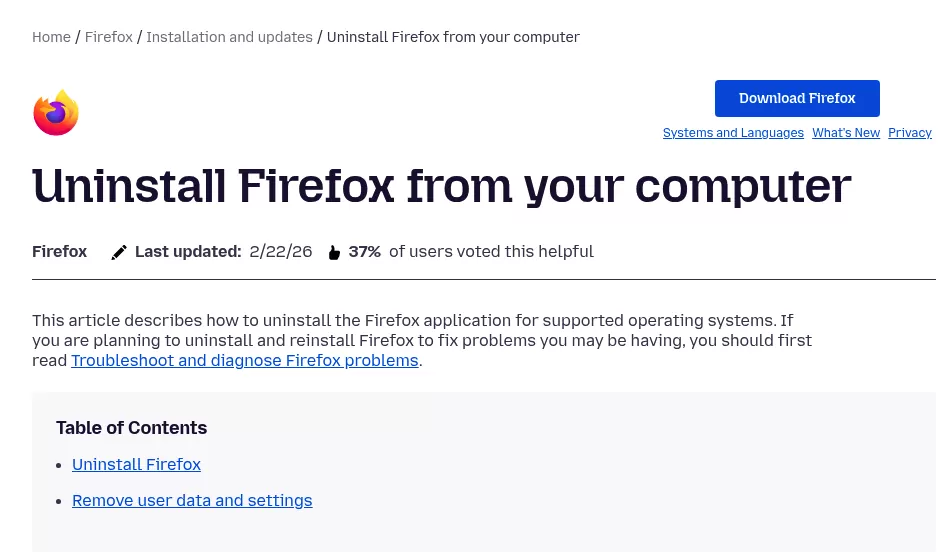
Apple notes that some apps sit in an Applications folder inside your home folder, so choose Go, then Home, and check there too. Also look for Firefox Developer Edition or Firefox Nightly.
Step 2: Delete the Firefox profile folder (only if you want your data gone)
Warning: this erases every Firefox profile stored in this folder, with its bookmarks, history, passwords, cookies and extensions. Only continue if you exported what you need or synced it.
Mozilla's route works without Terminal:
- Click Finder in the Dock.
- Click the Go menu, hold down the Option key and choose Library. The Library folder stays hidden until you do this.
- Open Application Support.
- Drag the Firefox folder to the Trash.
Or choose Go, then Go to Folder, and paste ~/Library/Application Support/Firefox. The tilde means your home folder. On the Mac we checked, this folder held Profiles, profiles.ini, installs.ini and Crash Reports, so one drag removes them all.

Step 3: Clear Firefox's cache folders
Firefox keeps its disk cache in your Caches folder. In Go to Folder, open ~/Library/Caches and drag the Firefox folder to the Trash. If the Local Directory you noted points somewhere else, clear that folder instead.
Delete the whole Firefox folder rather than digging inside it. Firefox hides each profile's cache folder. So Finder may show the Profiles folder as empty when it is not.
Firefox also keeps downloaded updates in ~/Library/Caches/Mozilla/updates, in a folder named after where the app lived, such as Applications/Firefox. Delete it, and delete the Mozilla folder too if nothing else is inside. Finder's Get Info shows how much space each folder took, and our list of disk space viewers compares tools that map the whole disk.
Step 4: Remove preferences and saved state
Firefox's bundle ID is org.mozilla.firefox, and macOS names some files after it. On the Mac we checked, one file existed: ~/Library/Preferences/org.mozilla.firefox.plist. Drag it to the Trash.
Then open ~/Library/Saved Application State and ~/Library/HTTPStorages and look for anything starting with org.mozilla.firefox. Our test Mac had none, so do not worry if yours is empty.
Leave the Mozilla folder in ~/Library/Application Support alone unless it is empty. Mozilla's native manifests page explains that other apps put files there so their Firefox add-ons work. Password managers are a common example, and on our test Mac it held one such file.
The same goes for the shared /Library/Application Support/Mozilla folder, which applies to every user on the Mac.
Step 5: Delete backups and exported files you no longer need
If you kept the backup file, delete it once you are sure you will not reinstall. It is where you chose when you turned backup on. Mozilla suggests searching for "Firefox backup" and checking Documents and cloud folders.
Also delete the Old Firefox Data folder on your Desktop, and the password .csv file once you have imported it.
Confirm nothing from Firefox is still running
Warning: emptying the Trash is permanent. Check that nothing you want is in there, then choose Finder, then Empty Trash.
Open Activity Monitor from Applications, then Utilities, and type Firefox in the search field. Once Firefox has quit, nothing should be listed.
Next, open System Settings, click General, then Login Items & Extensions, as Apple's Login Items guide describes. If Firefox shows under Open at Login, select it and click the Remove button.
Check the background list too: App Background Activity on macOS Tahoe 26 and later, or Allow in the Background on macOS Sequoia 15. If Firefox shows there, turn its switch off.

For a closer look, open Terminal from Applications, then Utilities. These commands only read; they change nothing. This one lists any running process with Firefox in its name:
pgrep -il firefoxThis one looks for Firefox or Mozilla items in your Library folders:
ls ~/Library/Application\ Support ~/Library/Caches ~/Library/Preferences ~/Library/Saved\ Application\ State ~/Library/HTTPStorages 2>/dev/null | grep -i -E 'firefox|mozilla'A Mozilla result is fine if it is the shared folder from Step 4. This one checks both Applications folders:
ls /Applications ~/Applications 2>/dev/null | grep -i firefoxThese two look for background jobs. Firefox's updater adds a helper named org.mozilla.updater when an update needs admin rights, and removes it when the update ends:
launchctl list | grep -i mozilla
ls /Library/LaunchDaemons /Library/PrivilegedHelperTools 2>/dev/null | grep -i mozilla
No output means these checks found nothing. It does not prove every trace is gone. The launchctl line only lists jobs for your own user, so the ls line is the real check for the updater helper.
If the last command lists org.mozilla.updater, the helper can sit in two places: /Library/PrivilegedHelperTools/org.mozilla.updater and /Library/LaunchDaemons/org.mozilla.updater.plist. Open each of those two folders with Go to Folder and drag only the org.mozilla.updater item in it to the Trash, entering your admin password when asked. Then empty the Trash and restart your Mac.
Reinstalling Firefox cleanly later
If you kept the Firefox folder from Step 2, a fresh install usually picks up your old profile. If you kept your backup, setup looks for a backup file and offers to restore it if it finds one.
For a clean start, delete both first. Signing in to your Mozilla account still brings back whatever you synced.
Frequently Asked Questions
Does Firefox have an uninstaller for Mac?
No. Mozilla's Mac steps are to quit Firefox and drag it from Applications to the Trash. There is no uninstall app to download.
Are my Firefox bookmarks and saved logins gone once the app is in the Trash?
No. They stay in the Firefox folder in Application Support until you delete it in Step 2. That is why a reinstall usually brings them back.
Why won't my Mac let me move Firefox to the Trash?
Usually Firefox is still open. Apple's advice when a Mac says an app is in use is to make sure it is not open, and if needed to restart or start up in Safe Mode, then try again.
How do I uninstall Firefox Developer Edition or Nightly on a Mac?
They install as separate apps named Firefox Developer Edition and Firefox Nightly, so drag each one to the Trash. Mozilla says each install gets its own profile, but they share one Profiles folder. To keep regular Firefox, open about:profiles in it, click Remove under the other edition's profile and choose Delete Files.
Does uninstalling Firefox on my Mac remove it from my other devices?
No, uninstalling and signing out only affect this Mac. Deleting your Mozilla account removes the synced copy Mozilla stores on its servers, but Mozilla says data already on your other devices stays on them. To clear a device, sign out there and tick Delete data from this device.
To delete the account itself, sign in at accounts.firefox.com, click Delete Account, tick the boxes and confirm with your password. That cannot be undone.
Removing other apps from this Mac
Firefox is one of the easier apps to remove. Others need more care: Sublime Text can leave a command line helper you set up, and security apps such as Trend Micro and Kaspersky ship their own uninstallers, which their vendors say to use instead of the Trash. Safari cannot be removed at all, and the Safari guide covers what to do instead.
Each guide covers what the app puts on your Mac, whether the vendor offers an uninstaller, the manual steps for what it leaves behind, and a final check. Nothing to download: just Finder, System Settings and, now and then, Terminal.